
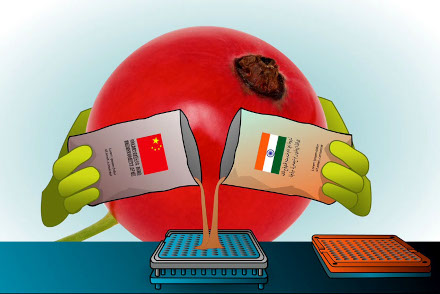
The United States faces a critical national security vulnerability: our dependence on China for the ingredients used to manufacture many common prescription drugs, including some essential medicines such as antibiotics and sterile injectables. This was not a random outcome; rather, it was the predictable result of China’s deliberate strategy, U.S. market failures, and decades of policy neglect.
The United States relies heavily on India for drugs — 4 out of 10 of all prescriptions and 47 percent of all generic prescriptions, according to IQVIA. But India, in turn, depends on China for about two thirds of the active pharmaceutical ingredients (APIs) needed to produce those drugs, according to a 2024 analysis by the Center for Strategic and International Studies.
This dependence has become a national security threat — and it didn’t happen overnight or for just one reason. Yet despite nearly three decades of warnings, key players moved forward with business as usual. This inaction — shortsighted and focused on the short term — has left the United States in a precarious position as global trade and military tensions mount.
How China captured pharmaceutical supply chains
China didn’t simply stumble into pharmaceutical dominance; it systematically engineered it. The shift accelerated dramatically after China joined the World Trade Organization in 2001, opening global markets to Chinese manufacturers operating with significant cost advantages. Beijing didn’t compete on natural advantages alone; it created artificial ones.
Government subsidies played a central role. Chinese pharmaceutical and chemical manufacturers received direct financial support, subsidized loans, tax breaks, and below-market land and energy costs. These weren’t temporary startup incentives but sustained competitive advantages that allowed Chinese firms to underprice Western competitors for years while building dominant market positions.
Equally important were China’s permissive environmental regulations, which allowed pollution-intensive pharmaceutical manufacturing with far lower compliance costs than in the United States or Europe. While Western regulators required expensive pollution-control systems and waste treatment, Chinese facilities could externalize these costs onto local communities and ecosystems. This regulatory gap created an artificial cost advantage — simply the difference between internalizing environmental costs versus dumping them on society.
Labor-cost advantages compounded these effects. As of the 2010s, average manufacturing wages in China were less than one fifth of those in the United States. This wage gap — combined with minimal labor protections and longer workweeks — gave Chinese producers a substantial cost advantage in labor-intensive stages of pharmaceutical and chemical production.
Taken together, these cost advantages allowed Chinese manufacturers to underprice global competitors and capture market share in pharmaceutical inputs. China controls a significant amount of global API production and dominates key chemical precursor production — not through superior technology or natural advantages, but through a highly effective mix of state support and regulatory leniency.
Rational business decisions eroded U.S. manufacturing
Domestic manufacturing — especially for low-cost generics and their chemical precursors — is capital intensive, strictly regulated, and offers only razor-thin profit margins. For decades, shareholders and management teams had strong incentives to source the lowest-cost inputs globally.
U.S. drug manufacturers’ decisions to offshore production were rational given shareholder pressure, payer demands for cost containment, and the reality that competitors were already moving offshore. China and India offered overwhelming cost advantages, making these countries the default option for companies trying to stay afloat.
Companies that resisted offshoring found themselves unable to compete against manufacturers that moved production to China or India. The cost differentials were too large to overcome through efficiency or innovation alone. As price competition intensified, many U.S. pharmaceutical companies offshored production or consolidated operations. Major companies like Merck and Mylan closed domestic manufacturing plants as part of broader cost-cutting strategies. And in one well-documented case, USAntibiotics’ Bristol, Tennessee factory — once a major domestic antibiotic producer — was squeezed by deep global price pressures and struggled to survive, despite local investment.
Environmental regulations widened the gap. U.S. manufacturers faced strict rules requiring costly pollution-control and waste-treatment systems. By offshoring production, companies could avoid domestic compliance costs. But what appeared as rational cost optimization ended up shifting environmental burdens abroad and creating dangerous supply-chain dependencies. Collectively, these choices produced a brittle system (e.g., shortages during COVID-19) with too much capacity concentrated overseas, leaving the United States vulnerable to disruptions and foreign leverage.
How policy inaction enabled dependency
From the 1990s onward, U.S. policymakers largely left drug manufacturing to market forces, failing to treat it as a strategic capability. While early government reports flagged quality-control concerns with foreign-made ingredients, they rarely considered supply chain resilience or geopolitical risk.
More fundamentally, policymakers overlooked that the United States was competing not just in a global marketplace, but against a coordinated state strategy. While American manufacturers made economically rational cost-cutting decisions, China was executing a state strategy to dominate pharmaceutical supply chains.
In part, this is understandable. Global supply chains often deliver lower prices, and regulators have focused primarily on safety because that’s what the current law requires. But policymakers discounted the risks of leaving drug manufacturing entirely to market forces — missing the long-term national security implications and the structural market failures that would ultimately leave the U.S. exposed.
Policymakers overlooked two key realities:
- Economic efficiency isn’t the same as strategic resilience. Just-in-time manufacturing and lowest-bidder sourcing created brittle supply chains that were highly vulnerable to geopolitical shocks, pandemics, and economic coercion.
- The market didn’t reward resilience. Maintaining domestic manufacturing capacity or building redundant supply chains would have required companies to absorb higher costs they couldn’t pass on to buyers in a price-sensitive, commoditized market. In the absence of government procurement commitments or a national strategy to support domestic production, few manufacturers had the incentive or ability to prioritize long-term resilience over short-term cost savings.
Building strategic resilience in pharmaceutical manufacturing
These policy failures weren’t incidental. We didn’t get here simply because market logic prevailed. We got here because policymakers didn’t account for how market logic conflicted with national security priorities. This classic market failure saw short-term cost optimization produce long-term strategic vulnerability — deferring necessary intervention and leaving the nation exposed.
In a capitalist system, there is a legitimate and necessary role for government to step in when markets misprice long-term risks or underprovide public goods. Prescription drugs should not be treated as a cost center to be minimized, but as a strategic capability to be protected and sustained, on par with defense and energy.
That’s the deeper lesson: In strategic sectors, government must shape markets continuously, not just intervene after they break.
Policy implications
What would it take to treat pharmaceutical manufacturing with the same strategic importance as semiconductors or critical minerals? Recent policy initiatives in those sectors offer a roadmap:
Strategic tariffs: On September 25, President Trump announced a new trade measure that, if implemented, would impose tariffs ranging from 25 to 100 percent on branded pharmaceuticals manufactured outside the United States or Europe. The policy exempts companies that have broken ground on U.S. manufacturing facilities and may offer reduced rates for imports from countries with favorable trade agreements, including a July 2025 deal with the European Union. While framed as a push to restore domestic pharmaceutical production, the announcement also suggested that many best-selling drugs could be exempt — introducing considerable uncertainty for firms evaluating long-term investment decisions.
Procurement commitments: The Department of Defense signed a 10-year offtake agreement — a long-term purchase commitment — with MP Materials to purchase domestically produced rare-earth magnets, providing market certainty to support U.S.-based processing. Government health programs like Medicare, Medicaid, the Veterans Affairs system could similarly commit to purchasing volumes of domestically produced medicines at predictable prices to provide manufacturers with the demand certainty needed to justify investing in U.S. production facilities.
Targeted production incentives: The Inflation Reduction Act includes the Section 45X Advanced Manufacturing Production Credit, which offers tax credits for domestic clean energy and battery production tied to U.S.-based output. A similar credit for pharmaceuticals could be tied to U.S. production of high-priority medicines, such as antibiotics and sterile injectable generics used in emergency and critical care settings. These categories have faced recurring shortages and are critical to public health and national preparedness. A targeted credit could reward firms that maintain or expand domestic manufacturing capabilities.
Tax-advantaged manufacturing zones: Under Section 936 of the U.S. tax code (1976-2006), companies received substantial tax benefits for manufacturing in Puerto Rico, which technically qualified as domestic production. This policy successfully maintained significant pharmaceutical manufacturing capacity within U.S. jurisdiction for three decades, as major companies like Pfizer, Bristol-Myers Squibb, and Abbott built extensive manufacturing operations there, producing both branded drugs and generic APIs. When Congress phased out Section 936[8] through the Small Business Job Protection Act of 1996, much of this production migrated to lower-cost overseas locations, contributing to the current dependency. This experience demonstrates both the effectiveness of targeted tax policy in sustaining pharmaceutical manufacturing and the risks of policy discontinuity.
Market exclusivity incentives: The pediatric exclusivity provision, which grants six additional months of market exclusivity to manufacturers conducting pediatric studies, has successfully incentivized research in an otherwise commercially unattractive area. Similarly, a manufacturing exclusivity provision could reward companies that maintain domestic production capabilities for essential medicines with extended market protection periods, creating sustainable business incentives for strategic manufacturing.
Public-private partnerships: The CHIPS and Science Act of 2022 authorized more than $52 billion in funding to support domestic semiconductor manufacturing, including through cost-sharing agreements with private companies. A similar model could share the financial risks of domestic pharmaceutical manufacturing through co-investment arrangements, loan guarantees, or risk-sharing agreements. These partnerships could focus on generics, particularly those that are essential medicines, where market incentives alone are insufficient to maintain domestic production.
The real test of any drug policy isn’t how it’s announced but whether it lasts. Rebuilding domestic manufacturing takes years of investment, approvals, and workforce training — and none of that is possible if the rules keep shifting. Companies making long-term bets need predictability, not uncertainty.
Without durable commitments, the United States will remain dependent on foreign sources for a wide range of pharmaceuticals, including some essential medicines. Only through sustained implementation of such policies can the United States rebuild the domestic pharmaceutical manufacturing capacity needed to ensure biosecurity and independence.