
On September 3, 2025, during an announcement to end all state vaccine mandates — including long-standing school immunization requirements — Florida Surgeon General Joseph Ladapo said, “Who am I, as a government, or anyone else — who am I as a man standing here now to tell you what you should put in your body? Who am I to tell you what your child should put in your body? I don’t have that right.” At the same event, Governor Ron DeSantis said, “Medical freedom is something we’ve got to be very conscientious about protecting.”
This view stands in sharp contrast to how other leaders have framed the issue. In July 2021, as California faced a surge in COVID-19 Delta-variant cases, Governor Gavin Newsom announced that state employees and healthcare workers would be required to show proof of vaccination or undergo weekly testing. Defending the policy, he said, “It’s a choice to live with this virus, and with all due respect, you don’t have the choice to go out and drink and drive and put everybody else’s lives at risk… You’re putting other people’s, innocent people’s lives at risk.” Where DeSantis and Ladapo see vaccine requirements as government overreach, Newsom sees them as protecting people from harm they don’t consent to bear — just like drunk-driving laws.
Comparing vaccination requirements to drunk-driving laws
Bodily autonomy
Critics of vaccine requirements invoke bodily autonomy as a fundamental right. Yet autonomy is limited when exercising it harms others who don’t consent. The key distinction in policy and ethics is between self-regarding risk — where a decision affects only the decision maker — and other-regarding risk, where it imposes harm on bystanders.
Where decisions involve only self-regarding risk, liberty generally prevails. But vaccine refusal, like drunk driving, involves other-regarding risk. Drunk-driving laws restrict the amount of alcohol people may consume before operating a vehicle. Smoke-free workplace laws restrict where people may smoke to protect coworkers. Drug-testing policies restrict what employees may consume to protect public safety. Society accepts these limits to prevent harm to others.
Vaccine refusal imposes risk on bystanders: the infant in the waiting room, the cancer patient at the store, the elderly neighbor at the community center. These people haven’t accepted the risk and often can’t avoid it. That is the boundary where public health justifiably limits liberty.
Probabilistic harm
Some vaccine-requirement critics note that not every unvaccinated person transmits disease, just as not every drunk driver causes a crash. But law operates on probability, not certainty. Where individual choices create statistical risk of serious harm to others, governments act based on likelihood. The state intervenes when probability and lack of consent justify prevention. The alternative — waiting for harm before acting — is not caution; it is neglect.
Temporal delay
Critics of vaccine requirements may object that drunk driving creates immediate danger while disease transmission involves a delay between exposure and harm. But what justifies government intervention is the victim’s inability to consent to the risk, not the speed of harm. Public health already acts on delayed harms: indoor-smoking bans prevent lung damage that appears years after exposure.
Which vaccines warrant requirements
The rational principle that the state may require vaccination does not mean all vaccines should be required for all people. Requirements should depend on evidence: How contagious is the disease? How severe are its effects on vulnerable populations? How effective is the vaccine at preventing transmission? Are there less-restrictive alternatives that adequately protect those at risk?
Measles meets a high threshold: it is highly contagious; it is dangerous to infants and immunocompromised individuals; and vaccines are highly effective. Seasonal influenza presents a different profile: lower transmission rates, variable vaccine effectiveness, and more options for targeted protection.
Requirements may be justified when evidence shows that voluntary vaccination leaves vulnerable populations exposed to serious, preventable harm they cannot avoid, and when no less restrictive measures adequately protect them. This is not a blanket endorsement — it is a call for evidence-based policy that weighs costs and benefits carefully.
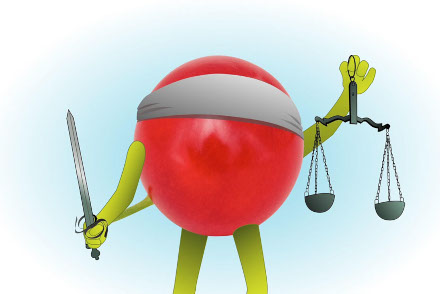
The symbols of justice
Classical depictions of Lady Justice offer a lens for examining what legitimate authority requires. She holds three elements, each representing a principle that should inform how public health officials exercise power.
The blindfold represents impartiality — evaluating evidence without regard to political pressure or popular sentiment. When data point in one direction and public opinion in another, officials must ground decisions in science, not politics.
The scales represent weighing competing claims — individual autonomy against collective protection. The task is to determine when one person’s freedom creates unacceptable risk for another’s survival. Weighing the evidence must be done vaccine by vaccine, population by population, based on evidence of transmission risk, disease severity, and vaccine effectiveness.
The sword represents authority to act once the weighing is complete. A state that identifies serious harm, weighs the evidence, and then refuses to act has made a choice—one that allocates risk to vulnerable populations.
When Dr. Ladapo asks, “Who am I to tell you what to do?” he suggests that exercising judgment is wrong. But public health leaders should impartially weigh the evidence and make a decision. Choosing not to act shifts risk to those least able to bear it: the infant, the immunocompromised, the elderly.